
Do Smartwatches Measure Calories Accurately?
Updated: Apr 9
Smartwatches have become indispensable tools in daily life for tracking physical activity and health. The calorie (energy expenditure) data provided by these devices directly influences users' decisions, especially in areas such as exercise planning and weight management. However, the reliability of this data is often accepted without question.
Energy expenditure is a physiological parameter that is difficult to measure directly, and smartwatches estimate this value through algorithms that take into account variables such as heart rate, movement, and speed . This can lead to significant differences in accuracy between different devices and different activities.
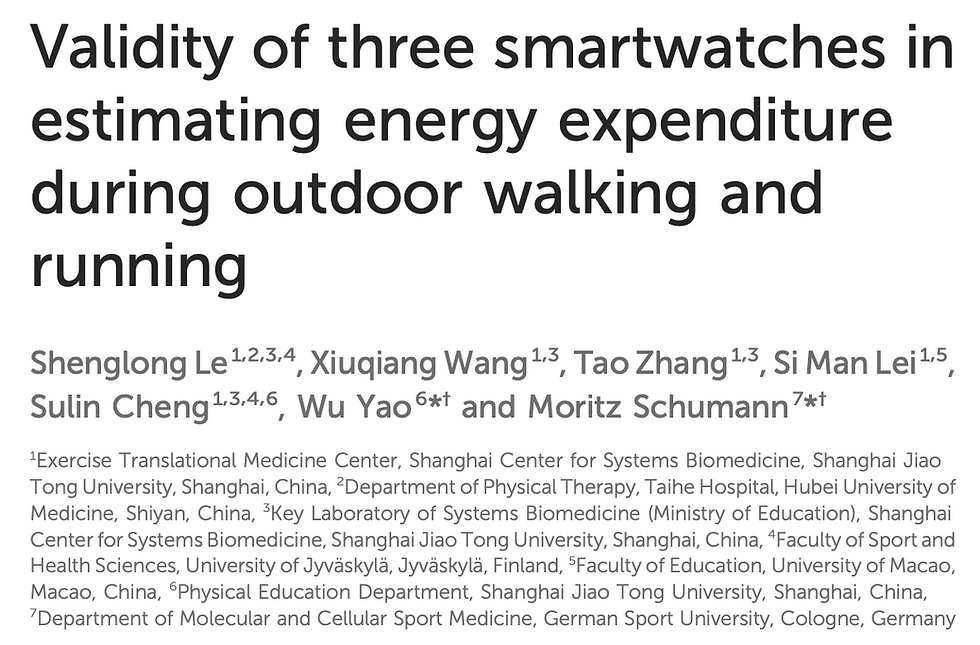
This article examines how accurately three popular smartwatches can estimate energy expenditure during walking and running, comparing their results to the gold standard indirect calorimetry , based on a controlled study published in 2022. The aim is to scientifically determine the reliability of the calorie data provided by smartwatches and how this data should be interpreted for daily use.
HOW DO SMARTWATCHES ESTIMATE CALORIES BURNED?
Smartwatches don't directly measure energy expenditure; instead, they generate statistical estimates using various physiological and movement data . These estimates are based on three main data sources: motion sensors (accelerometer), heart rate measurement, and GPS data .
Accelerometers provide information about the intensity of activity by detecting the user's movement amount and speed. Heart rate is also an important input for algorithms because it shows a linear relationship with energy expenditure. In outdoor activities, GPS data also comes into play, contributing to more accurate calculations of variables such as speed and distance covered.
This data is processed by manufacturer-specific algorithms, often not publicly disclosed , to generate calorie estimates. Therefore, two different smartwatches, even if collecting the same sensor data during the same activity, may produce different energy expenditure results . Furthermore, the type and speed of the activity, as well as the user's individual characteristics (body weight, age, gender), can significantly affect the accuracy of the estimate.
It is crucial to understand that the calorie values provided by smartwatches are estimates derived from modeling, not measurements . The main objective of this study is to determine the extent to which these estimates align with actual energy expenditure.
HOW WAS THE RESEARCH CONDUCTED?
The study examined was conducted using a controlled and realistic experimental design to evaluate the accuracy of calorie (energy expenditure) prediction by smartwatches . Twenty healthy young adults aged 18–30 with a normal body mass index participated in the study. All participants were selected from individuals who regularly engaged in physical activity.
The study tested three different smartwatches: the Apple Watch Series 6, the Garmin Fenix 6, and the Huawei Watch GT 2e . Participants wore all three watches simultaneously during each test, positioned according to manufacturer instructions. This allowed for direct comparison of data obtained during the same activity.
For the reference measurement of energy expenditure, the portable indirect calorimetry system (COSMED K5), considered the gold standard, was used. This system calculates energy expenditure with high accuracy by analyzing the amounts of oxygen taken in and carbon dioxide exhaled during respiration.
The exercise protocol was conducted outdoors, on a 400-meter athletics track.
Participants:
Walking 2 km at approximately 6 km/h ,
He ran 2 km at a speed of approximately 10 km/h .
A short rest period was given between each activity, and all devices were started and stopped simultaneously.
This approach allowed for an objective assessment of how accurately smartwatches can predict energy consumption in an environment similar to everyday usage conditions.
RESEARCH RESULTS
In this study, smartwatch energy consumption estimates were compared with the gold standard indirect calorimetry (COSMED K5) . The results show that all devices generally overestimate their energy consumption .
Walking (2 km, ~6 km/h)
Based on the reference measurement, the average energy expenditure was calculated as 108.7 kcal .
The predictions of smartwatches are as follows:
Apple Watch Series 6: ~129 kcal ( 19.8% error )
Garmin Fenix 6: ~140 kcal ( 32.0% error )
Huawei Watch GT 2e: ~111 kcal ( 9.9% error )

According to these results, only the Huawei Watch approached the acceptable accuracy limit with an error rate of less than 10% during walking.
Running (2 km, ~10 km/h)
In the reference measurement, the average energy expenditure was found to be 112.2 kcal .
Smartwatch predictions:
Apple Watch Series 6: ~138 kcal ( 24.4% error )
Garmin Fenix 6: ~131 kcal ( 21.8% error )
Huawei Watch GT 2e: ~112 kcal ( 11.9% error )

Error rates increased across all devices during the run, but the Huawei Watch still produced the results closest to the reference value.
General Commentary
Statistical analyses of the study show that the tested smartwatches have a moderate level of validity in predicting energy expenditure . In other words, while these devices can follow the general trend , the absolute calorie values can deviate to a degree that may mislead user judgment.
WHAT DO THESE RESULTS MEAN?
The findings of this study show that smartwatches offer a moderate level of accuracy in calorie (energy expenditure) estimates . While the devices can track general trends in energy expenditure, significant deviations can occur in absolute calorie values . In particular, systematically high calorie estimates can lead users to believe they are burning more calories than they actually are.
.
This is important in practice. For example, an individual trying to create a daily energy deficit with the goal of weight loss may not get the expected benefits from exercise based on smartwatch data. In the long run, such small deviations can result in the planned weight changes not being achieved .
On the other hand, these findings do not mean that smartwatches are worthless. These devices are useful tools for tracking relative changes over time and increases or decreases in activity levels. However, calorie data should be considered as approximate and contextual indicators , not as precise physiological measurements .
Some limitations of the study should also be considered. The findings were obtained only from young and healthy individuals and only included walking and running activities in open spaces. Therefore, the results cannot be directly generalized to different age groups, body compositions, or other types of exercise. In addition, since the algorithms used by smartwatch manufacturers are not publicly available, the source of measurement errors cannot be definitively determined.
For all these reasons, calorie data obtained from smartwatches needs to be interpreted with a conscious and critical approach. These devices can be supportive tools to guide the user; however, they do not replace scientific methods for the accurate measurement of energy expenditure.
Smartwatches offer valuable tools for tracking and raising awareness of physical activity. However, the calorie (energy expenditure) data provided by these devices should be considered approximate estimates rather than precise measurements . The scientific study examined reveals that popular smartwatches often overestimate energy expenditure during walking and running, and accuracy varies from device to device.
These findings do not mean that smartwatches should be completely disregarded. On the contrary, these devices are effective tools for monitoring changes in activity levels , maintaining exercise habits, and increasing motivation. However, it should be remembered that smartwatch data should not be the sole determining factor when making sensitive decisions such as weight management or energy balance .
In conclusion, calorie data from smartwatches is most accurate when used not as absolute numbers, but as guiding indicators showing trends over time . Conscious use and realistic expectations are essential for maximizing the benefits offered by wearable technologies.
Reference:
Le S, Wang X, Zhang T, Lei SM, Cheng S, Yao W, Schumann M. Validity of three smartwatches in estimating energy expenditure during outdoor walking and running. Front Physiol. 2022 Sep 26;13:995575. doi: 10.3389/fphys.2022.995575. PMID: 36225296; PMCID: PMC9549133.


Comments