
Muscle Loss During Starvation
Updated: Apr 9
Throughout evolution, humans have faced prolonged periods of food deprivation and have had to maintain their physical capacity to survive during these times. Therefore, the human metabolism has evolved to adapt to conditions of starvation. Today, however, fasting is mostly practiced voluntarily for weight loss or metabolic health purposes; its effects, particularly on muscle tissue and physical performance, are intensely debated. The significant decrease in body weight and lean body mass observed during fasting reinforces the perception that this process leads to muscle loss.
However, the concept of lean mass includes not only contractile muscle proteins but also muscle glycogen, intracellular water, and non-contractile proteins. Therefore, it is unclear whether a decrease in lean mass directly reflects changes in muscle function. While the metabolic effects of short-term fasting are well-defined in the current literature, the effects of longer-term fasting on the strength, endurance capacity, and muscle metabolism of large muscle groups have been investigated in a limited number of studies.
A study published in Nature Communications in 2025 comprehensively evaluates the effects of seven days of complete fasting on muscle strength, aerobic performance, and metabolic adaptations in humans. Furthermore, the study quantitatively analyzed how much of the observed lean mass loss during fasting corresponded to actual protein loss using urinary nitrogen measurements, and addressed the relationship between this loss and muscle function and strength using a holistic approach.

How was the study conducted?
PARTICIPANTS
The study included healthy, young individuals with prior exercise experience . A total of 15 participants were initially enrolled, but two were excluded from the analysis due to their inability to complete the fasting period. Thus, the study continued with 13 participants in total: 7 men and 6 women . Participants had no chronic illnesses and did not regularly take medication or use tobacco products. No serious side effects or clinical complications were reported during the study.
EXPERIMENTAL PROTOCOL
Participants consumed only water for seven days while continuing their normal daily activities. All measurements were taken after an overnight fast, and these measurements were repeated on the sixth and seventh days of fasting. Participants came to the laboratory daily for body weight measurement, blood sampling, and clinical evaluation . For safety purposes, continuous heart rate monitoring was performed, and the fasting period was monitored by healthcare personnel .
BODY COMPOSITION AND WEIGHT MEASUREMENTS
Body weight was measured using a high-precision digital scale. Dual-energy X-ray absorptiometry (DXA) was used for body composition analysis. This method separately assessed fat mass, lean body mass, and bone mineral content for total body, extremities, and trunk . Measurements were taken twice prior to fasting, and the average was used as a reference value.
MUSCLE STRENGTH TESTS
Muscle strength was assessed in the knee extensor muscles using isometric and isokinetic tests. The tests were performed using an isokinetic dynamometer. Participants achieved maximal contractions at different angular velocities, and the highest torque and average power values obtained were analyzed. These tests were performed before fasting and on the sixth day of fasting using the same protocol.
Aerobic Performance and Fat Oxidation Tests
Aerobic capacity was measured using a gradual load-increasing bicycle ergometer test, and maximum oxygen consumption (VO₂peak) was calculated . Additionally, a stepped exercise test at varying intensities was performed to assess maximum fat oxidation . During exercise, respiratory gases were continuously measured, and heart rate and perceived exertion level were recorded.
RESTING METABOLISM
Resting metabolic rate and substrate utilization were measured using indirect calorimetry. Measurements were performed in a quiet and controlled environment while participants rested in a supine position. This allowed for the determination of energy expenditure and fat and carbohydrate utilization rates before and during fasting.
BLOOD, URINE, AND MUSCLE BIOPSY ANALYSES
Daily blood samples were taken during the fasting period and analyzed for glucose, insulin, free fatty acids, and ketone bodies. 24-hour urine samples were collected to assess protein loss, and total nitrogen excretion was measured. Additionally, biopsies were taken from the vastus lateralis muscle before and at the end of the seven-day fasting period, and muscle glycogen, mitochondrial enzymes, and the expression of metabolic regulatory proteins were analyzed.
RESEARCH FINDINGS
CHANGES IN BODY WEIGHT AND COMPOSITION
During the seven-day fasting period, participants' body weight decreased by an average of 5–6 kg . This weight loss included both fat mass and lean mass components. According to DXA measurements, the total lean mass loss was approximately 4.6 kg , and the total fat mass loss was approximately 1.4 kg . No significant change was observed in bone mineral content. This means that most of the weight loss was from muscle mass rather than fat, but this doesn't necessarily mean it was entirely functional muscle loss. We will examine the reason for this shortly.
Lean mass loss occurred not only in the trunk but also in the arms and legs at similar rates. Approximately 6% lean mass reduction was observed in the upper and lower extremities. This finding indicates that the loss during fasting is systemic rather than localized.


THE RELATIONSHIP BETWEEN DECREASED PROTEIN INTAKE AND LEAN MASS LOSS AND MUSCLE MASS
To assess actual protein loss during fasting, nitrogen excretion was measured from 24-hour urine samples. Total nitrogen excretion over seven days was estimated at approximately 84 grams . Using known conversion coefficients, this corresponds to a protein loss of approximately 520 grams .
Considering the proportion of protein in the total lean mass of muscle tissue, this protein loss is equivalent to approximately 2.5–2.6 kg of lean mass . This indicates that the entire 4.6 kg of lean mass loss measured by DXA was not due to protein loss . A significant portion of the remaining loss is thought to be due to muscle glycogen and associated water loss, as well as intracellular fluid changes. Therefore, the decrease in lean mass was not directly interpreted as functional muscle loss.

MUSCLE STRENGTH
Muscle strength was assessed in the knee extensor muscles using isometric (force produced by the muscle at a fixed angle without movement) and isokinetic (force produced by the muscle along its axis of movement) tests.
Comparing measurements taken before fasting and on the sixth day of fasting, no significant change in maximal muscle strength was detected . Isokinetic torque values and average power outputs measured at different angular velocities were also preserved in the post-fasting period.
These results demonstrate that despite a significant loss of lean mass, the mechanical strength of the muscle was preserved . In other words, the fasting process did not lead to a measurable weakening of muscle function. Functional muscle loss leads to more severe losses in muscle strength, but no significant loss in maximal muscle strength was observed in the study.

Aerobic Capacity and Exercise Performance
A different picture emerged in the evaluation of aerobic performance. Maximal oxygen consumption (VO₂peak) decreased by approximately 13% after fasting . Similarly, the maximal power output achieved during exercise also decreased by approximately 15–16% .

The respiratory rate variation measured during exercise was found to be significantly lower in the post-fasting period. This indicates that carbohydrate utilization decreases during exercise, and energy production shifts more towards fat and ketone oxidation . In contrast, lactate levels and perceived exertion measured at the end of exercise were similar before and after fasting.


RESTING METABOLISM AND SUBSTRATE (BODY'S ENERGY SOURCE) UTILIZATION
Resting metabolic rate did not change significantly during fasting. However, energy substrate (the body's energy source) utilization differed considerably.
During rest, the contribution of fat oxidation to energy production increases, while the share of carbohydrate utilization decreases significantly.

During the maximal fat oxidation test, it was found that the rate of fat oxidation approximately doubled in the post-fasting period. Furthermore, this maximal fat oxidation was observed to occur at higher exercise intensities. These findings indicate that the metabolism strongly adapts to fat utilization during fasting.
BLOOD METABOLYTES AND KETONES
During fasting, resting blood glucose levels decreased, while free fatty acids and ketone bodies increased significantly.
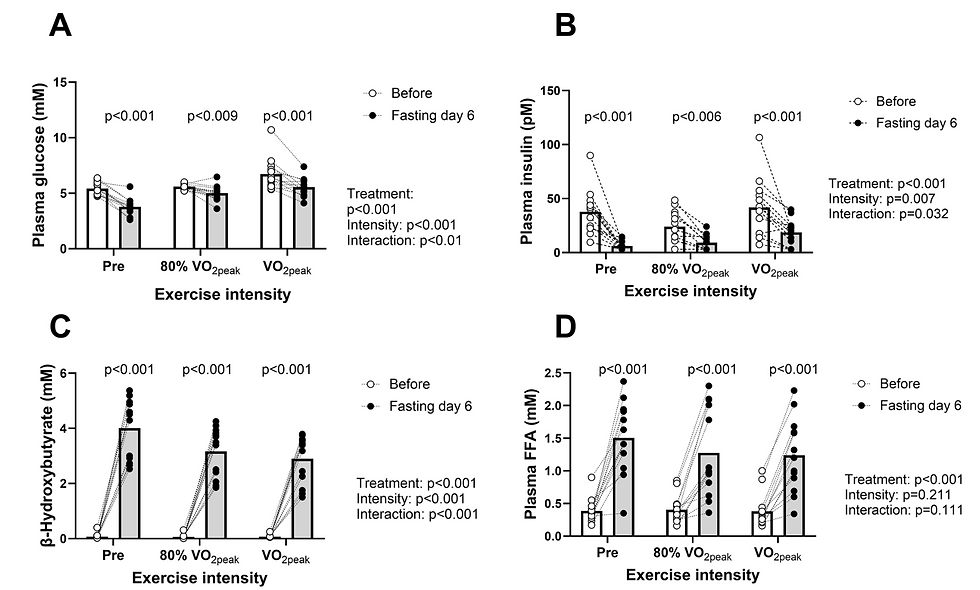
The decrease in ketone levels during exercise suggests that ketones are actively used as an energy substrate. Post-exercise glucose and insulin responses were also observed at lower intensities compared to the pre-fasting period.
MUSCLE BIOPSY FINDINGS AND METABOLIC ADAPTATIONS
Muscle biopsies showed that muscle glycogen content decreased by approximately 50% after fasting , but was not completely depleted. No significant changes were detected in the expression of mitochondrial oxidative enzymes and respiratory chain proteins.

In contrast, the production of the PDK4 protein, which suppresses carbohydrate oxidation, increased approximately 13-fold . This increase leads to the inhibition of the pyruvate dehydrogenase (PDH) enzyme, thus limiting carbohydrate utilization by the muscle .

CONCLUSION
This study demonstrates that the human body is more resilient to short-term starvation than previously thought. The preservation of muscle strength despite an extreme starvation period of seven days reveals that the body's priority is maintaining muscle function. The lean mass loss observed during starvation is largely due to changes in muscle glycogen, water, and intracellular fluids; it does not entirely correspond to functional muscle loss.
It appears that fasting affects endurance and performance more than muscle strength . Suppression of carbohydrate utilization and shift of energy production to fats and ketones leads to a decrease in high-intensity aerobic capacity. However, the mechanical strength of the muscle is largely preserved. These findings suggest that occasional skipped meals, short periods of fasting, or temporary dietary disruptions do not lead to significant muscle loss in healthy individuals.
However, the fasting protocol applied in this study was carried out under extremely controlled and clinically supervised conditions and is by no means a recommendation . Prolonged and uncontrolled periods of fasting can lead to serious health problems and actual functional muscle loss. This research does not show that fasting is harmless; rather, it demonstrates that the human body is not as fragile as commonly believed, even under extreme conditions.
Reference:
Kolnes KJ, Nilsen ETF, Brufladt S, Meadows AM, Jeppesen PB, Skattebo Ø, Johansen EI, Birk JB, Højlund K, Hingst J, Skålhegg BS, Kjøbsted R, Griffin JL, Kolnes AJ, O'Rahilly S, Wojtaszewski JFP, Jensen J. Effects of seven days' fasting on physical performance and Metabolic adaptation during exercise in humans. Nat Commun. 2025 Jan 2;16(1):122. doi: 10.1038/s41467-024-55418-0. PMID: 39747857; PMCID: PMC11695724.


Comments