
Is powerlifting unhealthy?

A systematic review published in the British Journal of Sports Medicine in 2017 ( Aasa et al. ) has been misinterpreted on social media for years.
Many people think this article says "powerlifting is risky." However, the article says the exact opposite:
Powerlifting and Olympic weightlifting have roughly the same injury rates as similar strength sports and lower rates than many other popular contact sports.

So the research shows that this sport is safer than expected , not "dangerous ." Nevertheless, to take these results out of context and interpret them as "powerlifting is harmful to health" simply because the word "injury" appears in an article showing injury rates, is to misunderstand not only the data but also the nature of science.
Moreover, the group in question here is not the entire population, but the competitors. Professional competitors, who make up only a very small percentage of athletes worldwide. In other words, this research was conducted not for people doing squats, deadlifts, and bench presses in the gym, but for elite powerlifters competing at an international level .
This nuanced difference is the essence of the whole debate. Professional sport is not training for health. Comparing the biomechanical load of a professional powerlifter to the "sports risk for healthy individuals" is as meaningless as seeing a Formula 1 driver's accident and saying "driving a car is harmful to health."
What does the article say, and what does it NOT say?
Aasa et al.'s review examined nine different studies and evaluated injury rates among professional powerlifting athletes . The results are as follows:
Sport | Injury Rate (per 1000 hours) |
Powerlifting | 1.0 – 4.4 |
Olympic Weightlifting | 2.4 – 3.3 |
Athletics (running, jumping) | 3.6 |
Wrestle | 5.7 |
American Football | 9.6 |
So statistically, the injury rate in powerlifting is:
Lower than athletics,
Much lower than wrestling and American football,
And it doesn't generally fall into the "high-risk sport" category.
Although the article explicitly states that this sport is perceived as risky, it carries similar risks to other sports, and is even less risky than many contact sports (wrestling, American football).


Despite making this clear, many people focus only on the word "injuries" and conclude, "so this sport causes injuries." However, scientific reading is about contextual interpretation, not just literal wording.
What percentage of the population does this group represent?
The subjects in this article are:
Professional powerlifters and weightlifters,
Elite athletes with 1 to 16 years of experience,
These are individuals who compete at the national or international level.
So these figures represent less than 1% of people who exercise worldwide . Therefore, showing this article and saying "look, powerlifting is harmful" is a statistical sampling fallacy .
Professional-level powerlifting pushes the body beyond its limits; however, it is not the same as strength training practiced by the general public.
The essence of powerlifting: Adaptation, not risk
Powerlifting is an adaptation process that maximizes the endurance and neuromuscular coordination of the human body . Fundamental movements such as squats, bench presses, and deadlifts are complex biomechanical models where muscles, tendons, ligaments, and bones work together.
When performed correctly, these movements:
It increases muscle mass and strength.
It increases bone mineral density,
It thickens the tendons,
It strengthens joint stability,
It supports metabolic and cardiovascular health.
So, when done in the right dosage, powerlifting doesn't injure the body; it strengthens it.
Is it wise to lift something too heavy?
The systematic review published by Tøien et al. in the Journal of Cachexia, Sarcopenia and Muscle in 2025 stands out as one of the most comprehensive analyses in the scientific literature. This study evaluates the effects of "heavy" (70–85% 1RM) and "very heavy" (85–95% 1RM) resistance training on muscle strength, physiological adaptation, health indicators, and safety in elderly individuals.
What is 1RM?
1RM (One Repetition Maximum) is the maximum weight with which you can perform an exercise completely only once. For example, if you can squat 80 kilograms and only one full repetition is possible, your squat 1RM is 80 kg.
Percentage ratios of this value are used to determine training intensity:
Density Level | Percentage | APPLICATION |
Light | 40–60% 1RM | Rehabilitation, mobility |
Middle | 60–75% 1RM | General fitness, endurance |
Heavy | 75–85% 1RM | Focused on strength and hypertrophy. |
Very Heavy | 85–95% 1RM | Maximal power, neuromuscular adaptation. |
Tøien's study demonstrates that loads of 85% and above are highly effective and safe, even in elderly individuals .

Research Findings: Safe, Powerful, and Effective, Even in Older Adults
The studies reviewed in the compilation include numerous clinical trials conducted on individuals aged 60 to 98. The results of these studies are surprisingly consistent.
Effect on Muscle Strength (1RM)
The strength gain in older individuals performing very heavy strength training was much greater than in older individuals training with low-to-medium weights, with an average strength increase of 2.5% per training session.

Furthermore, previous studies have shown that young individuals who train with very heavy weights experience greater strength gains.

Nervous System and Muscles
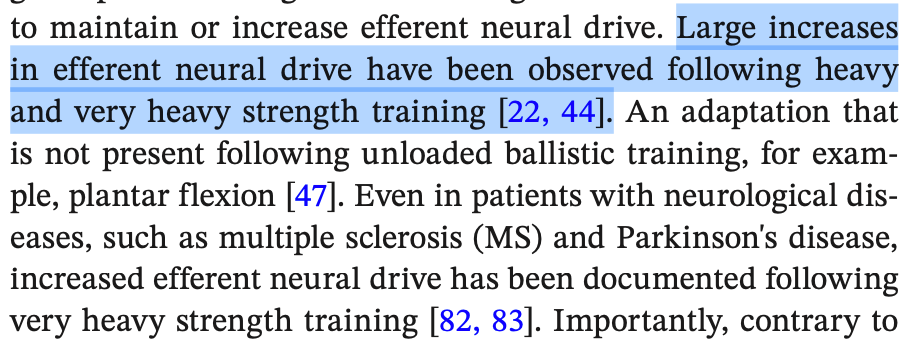
According to the analysis, age-related muscle decline is due not only to muscle loss but also to a decrease in neural activation (efferent neural drive) . When this neural signal from the brain to the muscles weakens, motor unit activation and the rate at which the muscle generates force (RFD) decrease.
Heavy (75–85% 1RM) and very heavy (85–95% 1RM) resistance training can reverse this decline. These workouts retrain the nervous system by increasing the number and firing rate of motor units , thus significantly improving reflexes, balance, and muscle control , even in older individuals.
This effect is not seen in low-intensity activities or activities like just walking. Even in patients with MS and Parkinson's disease , it has been shown that neural transmission is strengthened after very strenuous training .
At the muscle level, intense to very intense training has been reported to halt age-related losses in muscle cross-sectional area and volume , and to promote growth in both Type I and Type II muscle fibers .

Functional Performance and Activity of Daily Living
According to the research, maximum muscle strength (1RM) and rate of force production (RFD) are vital not only for physical performance but also for independence in daily life in older individuals.
Activities like getting up from a chair or climbing stairs become difficult when muscle strength decreases, and this rapidly reduces an individual's quality of life. Heavy and very heavy resistance training can prevent this loss and even restore strength to previous levels.
In conclusion, this type of training not only preserves muscle mass; it also helps older individuals maintain their mobility, self-confidence, and independence .
Popular misconception: “Injury = Harm”
To say that an activity is "harmful" simply because an injury occurs during that activity is not a valid conclusion in science. In medical literature, risk is assessed based on context, intensity, dose, technique, and individual factors.
If powerlifting is harmful based on its injury rate, then football, basketball, or running, which also have higher injury rates, should be considered "harmful to health" as well. But nobody makes such a claim.
The problem isn't with the sport itself; it's with how the data is interpreted.
Conclusion: Science favors power
Powerlifting, when practiced consciously, is a discipline that strengthens the human body, not injures it . Declaring this sport "harmful" based on data from a few elite athletes is not scientific, but rather a superficial interpretation. Furthermore, there are decades and hundreds of years of scientific evidence proving the benefits of resistance training.
The real danger is not in the barbell, but in the perspective that undermines scientific thinking.
References:
Tung MJ, Lantz GA, Lopes AD, Berglund L. Injuries in weightlifting and powerlifting: an updated systematic review. BMJ Open Sport Exerc Med. 2024 Dec 4;10(4):e001884. doi: 10.1136/bmjsem-2023-001884. PMID: 39650568; PMCID: PMC11624822.
Tøien T, Berg OK, Modena R, Brobakken MF, Wang E. Heavy Strength Training in Older Adults: Implications for Health, Disease and Physical Performance. J Cachexia Sarcopenia Muscle. 2025 Apr;16(2):e13804. doi: 10.1002/jcsm.13804. Erratum in: J Cachexia Sarcopenia Muscle. 2025 Aug;16(4):e70014. doi: 10.1002/jcsm.70014. PMID: 40241440; PMCID: PMC12003923.


Comments