
Myocardial Infarction: Everything You Need to Know About a Heart Attack

A heart attack can begin with something microscopic: a tiny disruption in the surface of an atherosclerotic plaque inside a coronary artery. Within minutes, platelets can accumulate, a blood clot can grow, blood flow can fall dramatically, and heart muscle that has been receiving oxygen every second of a person's life can suddenly become ischemic.
If blood flow is not restored, cells begin to die. This is myocardial infarction (MI). Despite enormous advances in cardiovascular medicine, myocardial infarction remains one of the most important medical emergencies worldwide. At the same time, our understanding of it has changed dramatically. A century ago, a major myocardial infarction was frequently fatal and treatment options were extremely limited. Today, a blocked coronary artery can sometimes be identified and reopened within hours—or even minutes—of a patient's arrival at hospital.
Understanding myocardial infarction therefore requires understanding two very different processes.
1) The first develops silently over years or decades: atherosclerosis.
2) The second can occur within minutes: acute coronary thrombosis and myocardial ischemia.
To understand a heart attack properly, we need to understand both.
What Is a Myocardial Infarction?
The term sounds complicated, but its meaning is relatively simple.
Myocardium means heart muscle.
Infarction means tissue death caused by inadequate blood supply.
A myocardial infarction therefore describes injury and death of heart muscle caused by ischemia—insufficient blood flow and oxygen delivery relative to the needs of the myocardium.
Most classic heart attacks occur because blood flow through a coronary artery is suddenly reduced or interrupted. Frequently, this happens when an atherosclerotic plaque becomes disrupted and a thrombus—a blood clot—forms over it.

But this is an important distinction:
Not every myocardial infarction is caused by an atherosclerotic plaque rupture or even by a coronary thrombus.
Anything that produces sufficiently severe myocardial ischemia can potentially cause infarction. This is why modern medicine distinguishes myocardial infarction from the broader concept of myocardial injury.
Heart attack is not the same as cardiac arrest
These terms are often used interchangeably in everyday conversation, but they describe different events.
A myocardial infarction is primarily a problem of blood flow to heart muscle.
A cardiac arrest is the sudden loss of effective cardiac mechanical activity and circulation.
A myocardial infarction can trigger a dangerous arrhythmia such as ventricular fibrillation and thereby cause cardiac arrest. But cardiac arrest can also occur for many other reasons.
Someone having a heart attack may therefore be completely conscious and talking. Someone in cardiac arrest is unresponsive and has no effective circulation.
PART I — HOW THE HEART RECEIVES BLOOD
The Heart Has Its Own Blood Supply

The heart pumps blood to almost every organ in the body, but the blood inside its chambers cannot adequately supply the thick muscular walls of the heart itself.
The myocardium therefore receives blood through the coronary arteries, which originate near the beginning of the aorta.
The left main coronary artery generally divides into two major branches:
the left anterior descending artery (LAD), supplying much of the anterior wall and interventricular septum;
the left circumflex artery (LCx), supplying much of the lateral and, depending on coronary anatomy, posterior myocardium.
The right coronary artery (RCA) supplies much of the right ventricle and inferior myocardium and commonly supplies the atrioventricular node. The exact territories vary between individuals because coronary anatomy and dominance differ.
This becomes clinically important because the location of a coronary obstruction influences the region of myocardium affected, the ECG abnormalities produced, the complications that may develop, and sometimes the patient's symptoms.
The Fundamental Equation: Oxygen Supply Must Meet Oxygen Demand
Heart muscle is metabolically active tissue. Cardiomyocytes continuously require oxygen to generate ATP and maintain contraction, ion gradients, and cellular integrity.
Think of myocardial oxygen balance as a continuously negotiated equation.
On one side is oxygen supply. This depends on factors including coronary blood flow, arterial oxygen content and hemoglobin concentration.
On the other side is oxygen demand. Demand rises with factors such as heart rate, contractility and ventricular wall stress.
Normally, supply is sufficient to meet demand. But imagine someone with a significantly narrowed coronary artery who develops severe anemia and a heart rate of 170 beats per minute. Oxygen-carrying capacity has fallen while myocardial oxygen consumption has risen dramatically. The coronary artery does not necessarily need to become completely blocked for ischemia to occur.
This concept—myocardial oxygen supply versus demand—is fundamental to understanding why not every MI has the same mechanism.
PART II — THE DISEASE THAT OFTEN STARTS DECADES BEFORE THE HEART ATTACK

Atherosclerosis Is More Than “Cholesterol Blocking an Artery”
One of the biggest misconceptions about coronary artery disease is that cholesterol simply accumulates inside an artery like grease accumulating inside a pipe. Atherosclerosis is much more biologically complex.
It is a chronic inflammatory disease of the arterial wall involving lipoproteins, endothelial cells, monocytes, macrophages, lymphocytes, vascular smooth-muscle cells, extracellular matrix, platelets and inflammatory signaling. The process can begin long before a person develops symptoms.
LDL enters the arterial wall
ApoB-containing lipoproteins—most importantly LDL particles—can become retained within the arterial intima. The endothelium is not merely an inert lining. It regulates vascular tone, inflammation, thrombosis and interactions between circulating blood and the vessel wall. When endothelial function becomes disturbed, retention and modification of lipoproteins within the intima promote an inflammatory response. Monocytes are recruited from the circulation and differentiate into macrophages. These macrophages ingest modified lipoproteins and can become lipid-filled foam cells. Collections of foam cells contribute to the earliest visible atherosclerotic lesions, often called fatty streaks.
From fatty streak to atherosclerotic plaque
Over time, the lesion can become increasingly complex. Smooth-muscle cells migrate and proliferate. Extracellular matrix, including collagen, is deposited. Lipid and cellular debris accumulate. Eventually, an atherosclerotic plaque may contain a lipid-rich necrotic core separated from circulating blood by a fibrous cap.
At this point, the important question is not simply “How narrow is the artery?”. It is also “How biologically unstable is the plaque?”.
A plaque producing severe chronic narrowing may cause predictable exertional angina.
Another plaque may not create such dramatic narrowing but may have characteristics that make it more susceptible to acute disruption. That second plaque can potentially be much more dangerous.
The Vulnerable Plaque
A classic plaque associated with acute coronary events is the thin-cap fibroatheroma. It typically contains a relatively large lipid-rich necrotic core covered by a thin fibrous cap and may contain substantial inflammatory activity. Macrophages and inflammatory mediators can contribute to degradation of extracellular matrix within the cap. If the structural integrity of that cap fails, the plaque can rupture. And when it ruptures, the situation can change extraordinarily quickly.
PART III — THE MOMENT A CHRONIC DISEASE BECOMES AN EMERGENCY
Plaque Rupture and Coronary Thrombosis
The inside of an intact coronary artery is designed to remain relatively non-thrombogenic. The contents underneath an atherosclerotic plaque's surface are different. When a fibrous cap ruptures, highly thrombogenic material becomes exposed to circulating blood. Platelets adhere to the damaged region. They become activated. Activated platelets release signaling molecules and recruit additional platelets. Platelets aggregate.
At the same time, the coagulation cascade promotes thrombin generation and fibrin formation, stabilizing the developing thrombus. The result can be a rapidly enlarging coronary thrombus. If it substantially obstructs the artery, blood flow to downstream myocardium falls. If it completely occludes the vessel, downstream myocardium can abruptly lose its normal arterial blood supply.
The sequence can therefore be summarized as:
Atherosclerosis → plaque disruption → platelet activation → thrombosis → coronary obstruction → ischemia → myocardial injury → myocardial infarction
Plaque erosion
Rupture is not the only mechanism. In plaque erosion, the endothelial surface is damaged without the classic rupture of a thin fibrous cap into a large lipid core. Thrombus can nevertheless form on the abnormal surface.
Calcified nodules
A less common mechanism involves disruption associated with a calcified nodule protruding into the lumen, again creating a surface capable of provoking thrombosis. These distinctions are not merely pathological curiosities. Modern intravascular imaging, particularly optical coherence tomography, can sometimes demonstrate the underlying morphology in living patients.
PART IV — WHAT HAPPENS TO HEART MUSCLE WHEN BLOOD FLOW STOPS?
Ischemia Comes Before Infarction
The myocardium does not die instantaneously when blood flow decreases. Initially, it becomes ischemic. When oxygen delivery becomes inadequate, oxidative phosphorylation declines and ATP production falls. Cells increasingly depend on anaerobic metabolism. Metabolic products accumulate. ATP-dependent ion pumps begin to fail. Intracellular ionic homeostasis deteriorates. Contractile function can become impaired remarkably early.
At this stage, some cellular injury may still be reversible if adequate perfusion is restored. But severe ischemia that continues long enough eventually causes irreversible cellular injury. Cardiomyocytes die. That is infarction.
Why “time is muscle”
Necrosis does not necessarily occur simultaneously throughout the entire ischemic territory.
In a prolonged severe coronary occlusion, irreversible injury tends to progress as a wavefront, generally beginning in the more vulnerable subendocardium and extending toward the epicardium over time. This gives us one of the most important principles in cardiovascular medicine: Time is muscle.
The longer a major coronary artery remains occluded, the greater the amount of myocardium that may become irreversibly damaged.
However, infarct size is not determined by time alone. It is influenced by:
the artery involved;
the location of the obstruction;
the size of the myocardial territory at risk;
collateral blood flow;
residual flow through the culprit vessel;
myocardial oxygen demand;
duration of ischemia;
and how rapidly reperfusion occurs.
This is why two people with apparently similar coronary occlusions can have very different outcomes.
Reperfusion: Saving Ischemic Myocardium
If the artery can be reopened before all threatened myocardium becomes irreversibly injured, some tissue may recover. This is reperfusion. Reperfusion is therefore not merely about making an angiogram look better. Its purpose is to save living myocardium.
Paradoxically, restoring blood flow can itself produce additional cellular stress—a phenomenon known as reperfusion injury. Oxidative stress, calcium overload, inflammation and mitochondrial dysfunction are among the mechanisms involved.
Nevertheless, the clinical benefit of timely reperfusion overwhelmingly outweighs this phenomenon when an acutely occluded coronary artery is threatening viable myocardium.
Stunning
Sometimes reperfused myocardium remains temporarily dysfunctional despite restoration of blood flow and absence of irreversible damage sufficient to explain the dysfunction. This is called myocardial stunning. The myocardium is alive, but its contractile function may take time to recover.
PART V — STEMI, NSTEMI AND THE MODERN CLASSIFICATION OF MI
STEMI and NSTEMI
Clinically, acute myocardial infarction has long been divided according to the initial ECG into ST-elevation myocardial infarction (STEMI) and non-ST-elevation myocardial infarction (NSTEMI).
STEMI
STEMI is characterized by qualifying ST-segment elevation in appropriate contiguous ECG leads in the relevant clinical setting. It often reflects an acutely occluded major epicardial coronary artery and requires an immediate reperfusion strategy.
NSTEMI
NSTEMI occurs when myocardial infarction is present without meeting STEMI ECG criteria. The ECG may show ST depression, T-wave abnormalities, nonspecific changes—or occasionally initially appear relatively unremarkable.
A common simplification says:
STEMI = complete occlusion
NSTEMI = partial occlusion
That is useful for introducing the subject, but it is not reliably true. Some patients with NSTEMI have a completely occluded culprit artery, while spontaneous reperfusion, collateral circulation, the location of the occlusion and the size of the affected territory can all influence the surface ECG. This is one reason clinicians interpret the ECG in its full clinical context rather than treating the STEMI/NSTEMI labels as perfect descriptions of coronary anatomy.
Transmural and subendocardial infarction
Historically, infarctions were described as “transmural” or “non-transmural,” and later as “Q-wave” and “non-Q-wave” infarctions. These classifications did not map as neatly onto pathology as once assumed.
Modern STEMI/NSTEMI terminology is principally an ECG-based clinical classification rather than a guarantee of the final anatomical depth of necrosis.
A Major 2026 Change: We No Longer Classify MI Simply as Types 1–5
For years, the Universal Definition divided myocardial infarction into numerical categories: Type 1, Type 2, Type 3, Type 4 and Type 5.
In August 2026, the Fifth Universal Definition of Myocardial Infarction replaced this numerical system with three clinically oriented categories:
Primary myocardial infarction
A primary MI arises spontaneously from an acute coronary pathology. Atherosclerotic plaque disruption with thrombosis is the classic example, but primary MI can also result from mechanisms such as:
spontaneous coronary artery dissection;
coronary vasospasm;
coronary embolism.
This is broader than the former Type 1 definition, which centered on acute atherothrombosis.
Secondary myocardial infarction
A secondary MI occurs when another acute condition creates a sufficiently severe mismatch between myocardial oxygen supply and demand.
Examples can include profound:
tachyarrhythmia;
hypotension or shock;
hypertension;
hypoxemia;
anemia,
particularly when the clinical circumstances and objective evidence support myocardial ischemia rather than nonspecific myocardial injury.
Procedure-related myocardial infarction
MI can also occur as a complication of cardiac procedures, including percutaneous and surgical procedures. The new classification consolidates what were previously several separate numerical procedural categories.
The important conceptual lesson is simple:
“Myocardial infarction” describes ischemic myocardial injury, but the mechanism producing that ischemia matters enormously because treatment depends on the cause.
Myocardial Injury Is Not Automatically Myocardial Infarction
This distinction is essential. Cardiac troponin indicates myocardial injury. It does not, by itself, tell us why that injury occurred.
Troponin can be elevated in patients with conditions such as:
acute or chronic heart failure;
myocarditis;
renal disease;
pulmonary embolism;
sepsis and critical illness;
tachyarrhythmias;
and other forms of cardiac stress or injury.
Therefore: Elevated troponin ≠ automatically MI.
To diagnose myocardial infarction, clinicians integrate the troponin pattern with evidence that the injury is related to myocardial ischemia, using symptoms, ECG findings, imaging and the clinical context.
The newest Universal Definition also emphasizes appropriate cardiac troponin reference limits, serial testing and accelerated pathways using high-sensitivity cardiac troponin.
PART VI — HEART ATTACKS THAT DO NOT FOLLOW THE CLASSIC STORY

Spontaneous Coronary Artery Dissection
SCAD occurs when separation within the wall of a coronary artery or intramural hematoma compromises the true lumen and restricts blood flow. It is particularly important because it can cause MI in people who do not resemble the stereotypical patient with advanced atherosclerotic disease. SCAD disproportionately affects women and has important associations with pregnancy and certain arteriopathies. Management can differ substantially from conventional atherothrombotic MI, making recognition important.
Coronary Vasospasm
A coronary artery can constrict intensely enough to severely reduce myocardial blood flow.
This coronary vasospasm may occur spontaneously or be precipitated by certain substances, including cocaine. Prolonged severe spasm can produce myocardial infarction.
Coronary Embolism
A thrombus does not necessarily have to form inside an atherosclerotic coronary plaque. Material can embolize into a coronary artery from elsewhere. Potential sources include intracardiac thrombi, prosthetic valves and infective processes involving valves.
Supply–Demand Imbalance
Suppose the coronary arteries are already moderately narrowed.
Now imagine the patient develops:
profound anemia;
severe hypoxemia;
septic shock and hypotension;
or sustained extreme tachycardia.
The heart may require more oxygen than the circulation can deliver. If myocardial ischemia becomes severe enough to cause infarction, this may constitute secondary MI under the current classification. The correct treatment therefore cannot simply be “put in a stent.”
The underlying cause of the imbalance must be identified and treated.
Myocardial Injury With Non-Obstructive Coronary Arteries
Historically, clinicians used the acronym MINOCA for myocardial infarction with non-obstructive coronary arteries.
The 2026 Universal Definition reframes this concept as myocardial injury with non-obstructive coronary arteries, emphasizing that finding non-obstructive arteries on angiography is a working diagnosis, not the end of the investigation. Further evaluation may reveal mechanisms such as coronary spasm, SCAD, embolic disease or other cardiac disorders. Cardiac MRI and more detailed coronary assessment can be especially valuable in establishing the actual cause.
PART VII — WHAT DOES A HEART ATTACK FEEL LIKE?
Symptoms of Myocardial Infarction
The classic symptom is central chest discomfort.
Patients may describe:
pressure;
heaviness;
squeezing;
tightness;
burning;
or a crushing sensation.
The discomfort can radiate to the:
left or both arms;
shoulders;
neck;
jaw;
back;
or upper abdomen.
Other symptoms can include:
shortness of breath;
sweating;
nausea;
vomiting;
weakness;
dizziness;
palpitations;
or syncope.
But real patients do not always read textbooks.
Atypical and silent presentations
Some myocardial infarctions present mainly with:
breathlessness;
unusual fatigue;
epigastric discomfort;
nausea;
weakness;
syncope;
or relatively mild chest discomfort.
Some are essentially silent.
Older people, people with diabetes, and some women may be more likely to present without the stereotypical crushing central chest pain, although classic chest discomfort remains common across groups. The crucial point is that symptoms alone cannot reliably confirm or exclude myocardial infarction.
PART VIII — WHAT SHOULD YOU DO IF YOU SUSPECT A HEART ATTACK?
Treat It as an Emergency
A suspected acute myocardial infarction requires urgent medical assessment. If someone develops symptoms strongly suggestive of a heart attack, emergency medical services should be contacted rather than waiting to see whether the symptoms disappear. Whenever practical, the person should not drive themselves to hospital. Emergency medical systems can begin assessment and treatment before hospital arrival and can coordinate transport to an appropriate cardiac center.
What about aspirin?
Aspirin inhibits platelet activation and is a cornerstone of treatment for many acute coronary syndromes.
However, chest pain has many causes, some of which can make antithrombotic therapy inappropriate or dangerous. Individual contraindications and allergies also matter. Emergency-dispatch or medical instructions should therefore be followed rather than using an online article as a substitute for individualized emergency care.
If the person collapses
If a person becomes unresponsive and is not breathing normally, the problem may now be cardiac arrest. Emergency services should be activated immediately, cardiopulmonary resuscitation initiated, and an automated external defibrillator used as soon as available.
PART IX — HOW DOCTORS DIAGNOSE MYOCARDIAL INFARCTION
The ECG
An electrocardiogram records electrical activity from different perspectives around the heart. Because ischemic myocardium behaves electrically differently from healthy myocardium, acute coronary ischemia can alter the ECG.

Important findings can include:
ST-segment elevation;
ST-segment depression;
T-wave abnormalities;
pathological Q waves;
and reciprocal changes.
ECG territories
As a useful approximation:
Anterior/septal changes — V1–V4: often associated with the LAD.
Lateral changes — I, aVL, V5–V6: may involve the LCx or LAD territory.
Inferior changes — II, III, aVF: often associated with the RCA, although the LCx can be responsible depending on coronary dominance.
Posterior infarction may manifest as reciprocal abnormalities in anterior leads and can be evaluated with posterior leads such as V7–V9. Right ventricular involvement can be assessed with right-sided leads when clinically appropriate.
These relationships are valuable—but coronary anatomy varies, so the ECG is not a perfect anatomical map.
Reciprocal changes
An infarction producing ST elevation in one territory may produce ST depression in electrically opposite leads. These reciprocal changes can strengthen suspicion that ST elevation represents acute ischemic injury.
Troponin: The Biomarker at the Center of MI Diagnosis
Troponins are proteins involved in muscle contraction. Cardiac-specific troponin I and troponin T can enter the circulation when cardiomyocytes are injured.
Modern high-sensitivity cardiac troponin assays can detect extremely small concentrations and allow clinicians to evaluate dynamic changes over relatively short intervals.
The interpretation involves more than asking whether the value is “positive.”
Clinicians consider:
the assay-specific upper reference limit;
serial concentrations;
whether there is a meaningful rise and/or fall;
symptoms;
ECG findings;
imaging;
timing;
renal function and other clinical conditions.
This is why a troponin value should never be interpreted in isolation.
Echocardiography
Echocardiography uses ultrasound to visualize the beating heart.
After an MI, it can identify:
regional wall-motion abnormalities;
reduced ventricular function;
ejection fraction;
acute mitral regurgitation;
ventricular septal defects;
pericardial effusion;
and other complications.
It is particularly valuable when the diagnosis or hemodynamic consequences are uncertain.
Coronary Angiography
Coronary angiography can show clinicians where a coronary artery is narrowed or occluded.
A catheter is advanced into the arterial system, contrast is injected into the coronary arteries, and X-ray imaging demonstrates the coronary lumen.
The enormous advantage is that diagnosis can immediately become treatment.
If an appropriate culprit lesion is identified, percutaneous coronary intervention (PCI) can often be performed during the same procedure.
PART X — TREATING THE HEART ATTACK
The Main Goal: Restore Blood Flow
For an acute coronary occlusion, one principle dominates: Restore perfusion as quickly and safely as possible.
Primary PCI
Primary PCI is the preferred reperfusion strategy for STEMI when it can be performed within the appropriate timeframe by an experienced team.

During PCI, a guidewire is passed across the lesion. The obstructed segment can be dilated, and in most conventional atherosclerotic culprit lesions a stent is implanted to scaffold the artery open. Modern drug-eluting stents also release medication that reduces excessive tissue growth and restenosis. Blood flow can sometimes be restored almost immediately. The faster this happens, the greater the opportunity to salvage threatened myocardium.
Fibrinolysis
When timely primary PCI cannot be provided in appropriate STEMI presentations, fibrinolytic therapy may be used in eligible patients. Fibrinolytic drugs promote breakdown of fibrin within thrombus and can restore coronary flow.
However, they carry important bleeding risks, including intracranial hemorrhage, and are not appropriate for every patient. Even after successful fibrinolysis, patients are generally managed within a strategy that includes transfer to a PCI-capable center and coronary angiographic assessment.
Antiplatelet Therapy
Because platelet activation is central to acute coronary thrombosis, antiplatelet therapy is fundamental. Aspirin inhibits platelet thromboxane production. P2Y12 inhibitors—such as clopidogrel, ticagrelor or prasugrel in appropriate settings—target another major pathway of platelet activation.
After ACS, dual antiplatelet therapy (DAPT) commonly combines aspirin with a P2Y12 inhibitor. The optimal agent and duration depend on factors including PCI, ischemic risk, bleeding risk and whether the patient also requires anticoagulation.
Current guidelines use approximately 12 months of DAPT as a common default after ACS in patients without high bleeding risk, while allowing individualized shorter or modified strategies in appropriate patients.
Anticoagulation and Other Acute Treatments
Anticoagulant drugs are used in many acute coronary syndrome pathways to reduce further thrombin generation and clot propagation. Other treatments depend on the patient's physiology.
Oxygen
Oxygen sounds intuitively beneficial during a heart attack, but more oxygen is not automatically better. Routine oxygen supplementation is not necessary in a patient whose blood oxygenation is adequate. It is used when hypoxemia or another appropriate clinical indication is present.
Nitrates
Nitrates can relieve ischemic discomfort and reduce cardiac workload in selected patients, but they are not appropriate in every situation—for example, significant hypotension or certain right ventricular infarctions require particular caution.
Beta-blockers
Beta-blockers can reduce heart rate, blood pressure and myocardial oxygen demand and have important roles in selected patients, but acute use must account for heart failure, shock risk, conduction abnormalities and other contraindications.
Modern MI treatment is therefore not a universal “cocktail.” It is individualized according to the patient's mechanism, hemodynamics, ECG, coronary anatomy and comorbidities.
When Is Bypass Surgery Needed?
PCI is extraordinarily effective, but not every coronary problem is best treated with a stent.
Coronary artery bypass grafting (CABG) may be considered in selected patients with complex coronary anatomy, significant left-main or multivessel disease, failed or unsuitable PCI, or certain mechanical and ischemic situations.
In CABG, graft vessels create new routes for blood to travel around severely diseased coronary segments. The decision between PCI and CABG depends on anatomy, clinical urgency, ventricular function, comorbidities and other patient-specific factors.
PART XI — COMPLICATIONS
Electrical Complications
Ischemic myocardium is electrically unstable.
Potential arrhythmias include:
ventricular tachycardia;
ventricular fibrillation;
atrial arrhythmias;
bradyarrhythmias;
and atrioventricular block.
Ventricular fibrillation is particularly dangerous because coordinated ventricular contraction disappears. Cardiac output effectively falls to zero. Without rapid defibrillation and resuscitation, death can occur within minutes. This is one mechanism by which myocardial infarction can lead to sudden cardiac arrest.
Acute Heart Failure and Cardiogenic Shock
If enough functioning myocardium is lost, the heart may no longer generate adequate cardiac output. Patients can develop acute heart failure and pulmonary edema. At the extreme lies cardiogenic shock.
In cardiogenic shock, cardiac output becomes inadequate to maintain sufficient organ perfusion despite appropriate filling conditions. Blood pressure may fall. The kidneys, brain and other organs become underperfused. A vicious cycle can develop in which poor coronary perfusion worsens myocardial function, which further worsens systemic perfusion.
Despite modern reperfusion and intensive care, cardiogenic shock remains one of the most dangerous complications of acute MI.
Mechanical Complications
Some of the most dramatic complications occur when infarcted tissue physically fails.
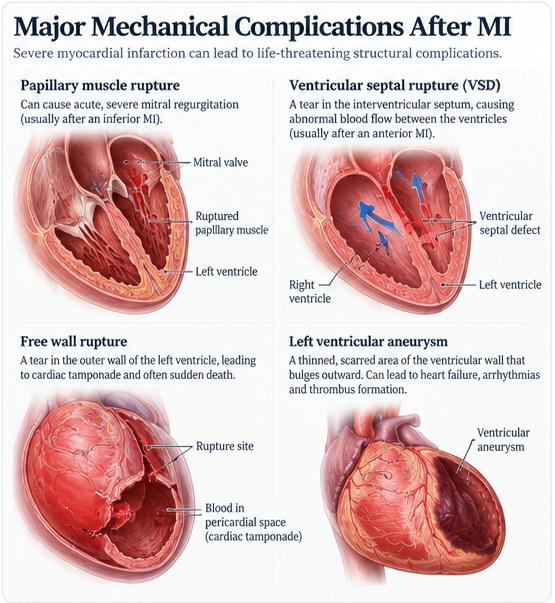
Papillary muscle rupture
Papillary muscles help stabilize the mitral valve. Rupture can produce sudden, severe mitral regurgitation, pulmonary edema and cardiogenic shock.
Ventricular septal rupture
Necrotic tissue in the interventricular septum can rupture, creating an abnormal communication between the left and right ventricles. This can cause rapid hemodynamic deterioration.
Free-wall rupture
Rupture of the ventricular free wall can cause blood to enter the pericardial space.
Rapid accumulation produces cardiac tamponade, preventing normal cardiac filling and potentially causing sudden death. Mechanical complications are uncommon in the modern reperfusion era but remain medical and often surgical emergencies.
Pericarditis, Thrombus and Ventricular Aneurysm
Inflammation after transmural myocardial injury can involve the pericardium and cause post-infarction pericarditis. A later immune-mediated syndrome classically known as Dressler syndrome can also occur.
Poorly contracting infarcted myocardium—particularly in the left ventricular apex—can encourage blood stasis and mural thrombus formation. If part of the thrombus embolizes, it can enter the systemic circulation and potentially cause stroke or other organ infarction. Extensive infarction can also alter ventricular geometry, producing adverse remodeling and, in some cases, a chronic ventricular aneurysm.
PART XII — LIFE AFTER A HEART ATTACK
Opening the Artery Is Only the Beginning
A successful stent can transform an acute emergency. But a stent does not cure atherosclerosis. It treats a specific lesion. If the patient has systemic atherosclerotic disease, the biological processes that produced the culprit plaque may also be operating elsewhere in the coronary circulation and other arteries. This is why secondary prevention is crucial.
Medications After MI
Treatment is individualized, but commonly important therapies include:
Antiplatelet therapy
Reduces recurrent thrombotic events, particularly after coronary stenting.
Intensive LDL lowering
Statins are foundational because reducing LDL-containing atherogenic lipoproteins substantially reduces future cardiovascular risk. If LDL-C remains above the patient's treatment goal, additional therapies such as ezetimibe, PCSK9-directed treatment or other evidence-based lipid-lowering agents may be considered depending on the clinical situation. Modern European guidance increasingly emphasizes early intensive lipid lowering during the hospitalization for ACS, rather than waiting months to address residual cholesterol risk.
Renin–angiotensin system therapies
ACE inhibitors, ARBs and related heart-failure therapies may be important in appropriate patients, particularly when ventricular dysfunction, hypertension, diabetes or heart failure is present.
Beta-blockers
Their long-term role depends on factors including ventricular function, arrhythmia risk and other indications.
Treatment after MI is therefore increasingly individualized rather than assuming every survivor needs the same drugs forever.
Cardiac Rehabilitation
Cardiac rehabilitation is one of the most valuable—and sometimes underused—components of recovery.
A comprehensive program can include:
supervised or prescribed exercise;
risk-factor modification;
nutritional guidance;
smoking cessation;
psychological support;
medication optimization;
education;
and a structured return to normal activity.
A heart attack does not necessarily mean a life of physical inactivity. For many patients, appropriately prescribed exercise becomes part of the treatment.
PART XIII — PREVENTING THE FIRST HEART ATTACK
The Best Heart Attack Is the One That Never Happens
A myocardial infarction may occur suddenly. Atherosclerosis usually does not.
It often develops silently for decades. This creates a major opportunity for prevention.
LDL and ApoB-containing particles
One of the strongest causal drivers of atherosclerotic cardiovascular disease is prolonged exposure of the arterial wall to apoB-containing lipoproteins, particularly LDL. Risk is influenced not merely by a cholesterol measurement on one particular day, but by cumulative exposure over time. This is why prevention increasingly focuses on controlling atherogenic lipoproteins earlier rather than waiting until coronary disease becomes symptomatic.
Blood pressure
Hypertension accelerates vascular damage and substantially increases cardiovascular risk.
Detecting and controlling it is one of the most powerful preventive interventions available.
Smoking
Tobacco exposure promotes endothelial dysfunction, inflammation, thrombosis and multiple other mechanisms that increase cardiovascular risk. Smoking cessation can produce substantial reductions in risk.
Diabetes and metabolic health
Diabetes is a major cardiovascular risk factor and often coexists with hypertension, dyslipidemia, obesity and other metabolic abnormalities.
Physical activity
Regular physical activity improves cardiovascular fitness, blood pressure, insulin sensitivity, body composition and numerous other cardiovascular risk markers.
Diet
Dietary patterns emphasizing minimally processed foods, vegetables, fruits, legumes, whole grains, nuts and appropriate sources of unsaturated fats can form part of a cardiovascular prevention strategy.
Lipoprotein(a): The Risk Factor Many People Have Never Measured
Lipoprotein(a), or Lp(a), is an apoB-containing lipoprotein whose concentration is largely genetically determined. Elevated Lp(a) is associated with increased atherosclerotic cardiovascular risk. Because lifestyle has relatively limited influence on Lp(a), knowing that it is markedly elevated can change how clinicians interpret a person's overall risk and how aggressively other modifiable risk factors are treated.
Recent European guidance recommends considering Lp(a) measurement at least once in adulthood and recognizes elevated Lp(a) as an important cardiovascular risk modifier.
This is a good example of why the statement “My cholesterol is normal, so I cannot have a heart attack” is far too simplistic.
Inflammation Matters Too
Atherosclerosis is both a lipid-driven and inflammatory disease. Inflammation contributes to plaque formation, progression and destabilization. Markers such as high-sensitivity C-reactive protein can provide information about residual inflammatory risk in selected clinical settings. But this does not mean that a person should simply attempt to “lower inflammation” with supplements. Effective cardiovascular prevention targets established causal risk factors and uses therapies supported by outcome evidence.
PART XIV — THE VULNERABLE PLAQUE OR THE VULNERABLE PATIENT?
Why Can't We Simply Find Every Dangerous Plaque and Stent It?
This sounds like an obvious solution. Find the plaques that are going to rupture. Put stents in them. Prevent heart attacks. Unfortunately, biology is not that simple.
A patient can have numerous plaques throughout the coronary circulation. Plaques evolve. Some heal. Some enlarge. Some undergo silent disruption. Features associated with vulnerability do not perfectly predict which individual plaque will cause a future event.
This has shifted attention from simply hunting for one “dangerous” narrowing toward identifying the vulnerable patient and reducing the overall probability of future plaque disruption and thrombosis.
PART XV — COMMON MYTHS
“Heart Attacks Only Happen to Old People.”
Risk rises substantially with age, but young adults can have myocardial infarction. Genetic lipid disorders, smoking, diabetes, elevated Lp(a), SCAD, substance use, inflammatory disease and other conditions can produce coronary events at younger ages.
“A Heart Attack Always Causes Terrible Chest Pain.”
No.
Some infarctions cause dramatic crushing pain. Others cause breathlessness, nausea, weakness, epigastric discomfort or relatively subtle symptoms. Some are silent.
“A Normal ECG Means I Didn't Have a Heart Attack.”
No.
The ECG is extremely important but is not perfectly sensitive. NSTEMI can occur without dramatic initial ECG abnormalities, which is why serial ECGs, troponin measurements and clinical assessment are important.
“High Troponin Means Heart Attack.”
Not necessarily.
High troponin means myocardial injury. The cause of that injury must then be determined.
“Once I Have a Stent, My Heart Disease Is Fixed.”
A stent can fix a culprit obstruction. It does not remove the biological tendency toward atherosclerosis throughout the rest of the arterial system. Secondary prevention remains essential.
“I'm Fit, So I Can't Have Coronary Disease.”
Fitness substantially improves cardiovascular health, but it does not make someone biologically immune to atherosclerosis. Genetics, LDL/ApoB exposure, Lp(a), smoking, blood pressure, diabetes, age and other factors still matter. Exercise is powerful medicine. It is not a force field.
PART XVI — THE ENTIRE HEART ATTACK IN ONE CHAIN
For the classic atherothrombotic heart attack, everything we have discussed can be condensed into one biological sequence:
Risk factors and genetic susceptibility
↓
Endothelial dysfunction and retention of apoB-containing lipoproteins
↓
Inflammation
↓
Foam-cell and atherosclerotic plaque formation
↓
Progression to an unstable plaque phenotype
↓
Plaque rupture or erosion
↓
Platelet activation and coagulation
↓
Coronary thrombus
↓
Reduced or interrupted coronary blood flow
↓
Myocardial ischemia
↓
ATP depletion and cellular dysfunction
↓
Irreversible cardiomyocyte injury
↓
Myocardial necrosis
↓
Troponin release ± ECG abnormalities ± symptoms
↓
Diagnosis of myocardial infarction
↓
Rapid reperfusion and evidence-based medical therapy
↓
Myocardium saved
↓
Secondary prevention to reduce the probability of the next event
Key Takeaways
A myocardial infarction is ischemic injury and death of heart muscle.
The classic heart attack occurs when an atherosclerotic plaque becomes disrupted, triggering coronary thrombosis.
Atherosclerosis is not simply cholesterol clogging a pipe. It is a chronic disease of the arterial wall involving apoB-containing lipoproteins, inflammation, vascular cells and the immune system.
Plaque rupture is common, but plaque erosion, SCAD, vasospasm, embolism and oxygen supply–demand imbalance can also cause myocardial infarction.
STEMI and NSTEMI describe important ECG-based clinical presentations, but they do not perfectly distinguish complete from incomplete coronary occlusion.
The 2026 Fifth Universal Definition now classifies MI as primary, secondary or procedure-related rather than using the previous Type 1–5 system.
Elevated troponin means myocardial injury; it does not automatically mean myocardial infarction.
When an acute coronary artery occlusion is present, rapid reperfusion—usually with PCI when promptly available—can save viable myocardium. Time is muscle.
Dangerous complications include ventricular arrhythmias, heart failure, cardiogenic shock and mechanical rupture.
A stent treats a lesion, not the systemic disease that created it. Secondary prevention is therefore essential.
Many of the biological processes that eventually produce a heart attack begin decades before symptoms appear.
Controlling LDL/ApoB exposure, blood pressure, smoking, diabetes, physical inactivity and other cardiovascular risk factors remains one of the most effective ways of preventing myocardial infarction.
A heart attack may appear to happen in a moment. The disease behind it often does not. And that is precisely why understanding myocardial infarction is important: modern medicine is remarkably good at reopening an artery after catastrophe has begun, but the greater opportunity is to recognize and control the disease long before that artery ever closes.
Medical Disclaimer
This article is provided for educational and informational purposes only and does not constitute medical advice, diagnosis, or treatment. It should not replace consultation with a qualified healthcare professional.
Medical information and guidelines may change over time, and Intellicorpus does not guarantee that all information is complete or applicable to every individual. Intellicorpus and its authors are not responsible for decisions or outcomes resulting from reliance on this content.
If you think you or someone else may be experiencing a heart attack or other medical emergency, contact emergency medical services immediately. Do not delay seeking professional care because of information in this article.
References:
Saleh M, Ambrose JA. Understanding myocardial infarction. F1000Res. 2018 Sep 3;7:F1000 Faculty Rev-1378. doi: 10.12688/f1000research.15096.1. PMID: 30228871; PMCID: PMC6124376.
Mills, N, Newby, L, Zaman, S. et al. Fifth Universal Definition of Myocardial Infarction (2026). JACC. null2026, 0 (0) .
https://www.aclsmedicaltraining.com/ecg-in-acute-myocardial-infarction


Comments