
Genetic Inheritance of Exercise
Updated: Apr 9
A study published in the journal Cell Metabolism in 2025 caused a stir in the scientific world: “Paternal exercise confers endurance capacity to offspring through sperm microRNAs.” In short, “A father's exercise confers endurance to his child through microRNAs in his sperm.”

EPIGENETICS: THE CONTROL LAYER OVER GENES
We all inherit our genetic legacy from our parents. But genes alone are not destiny. There is an overarching layer that determines when , how much , and under what conditions they become active: epigenetics. Although the genetic code is the same in all cells in the body, what distinguishes a nail cell from an eye cell is which parts of the genetic code in the cell are active and which parts are inactive.
Epigenetics refers to mechanisms that alter the behavior of genes without changing their sequence. In other words, the DNA remains the same, but the way it's read—like reading different chapters of the same book—can change. This change is shaped by lifestyle factors such as diet, stress, sleep, toxins, and exercise.
And recent findings show that these epigenetic markers can affect not only the individual but also their children .
PURPOSE OF THE EXPERIMENT
The researchers were pursuing the following question:
"Can a father's lifestyle — especially exercise — affect his child's physical performance and metabolic capacity?"
At the heart of this problem lay the idea of non-genetic (epigenetic) inheritance. If a lifestyle habit can leave a biochemical trace in a sperm cell, that trace can also affect embryonic development.
HOW WAS THE EXPERIMENT PLANNED?
In the study, male mice were divided into two groups:
Fathers who exercised: They worked out regularly on the treadmill for eight weeks.
Sedentary fathers: Kept in the same conditions, but without exercise.
These male mice were then mated with unexercised females. The resulting offspring (F1 generation) were measured for muscle mass, metabolic capacity, oxygen utilization, mitochondrial density, and endurance.

Researchers also isolated RNA from the sperm of exercising fathers and injected this RNA into fertilized eggs. Their aim was to determine whether the effect was transmitted via DNA or RNA .

Results
The results painted a picture that went beyond classical genetic inheritance.
Physical Performance:
The offspring of exercising fathers (F1-Et) were able to last longer on the treadmill and were less tired.
Blood lactate levels were lower during the fatigue test — this indicates less “exhaustion” in energy production.
Their oxygen consumption rates ( VO₂ ) were higher, indicating that their muscles used energy more efficiently.
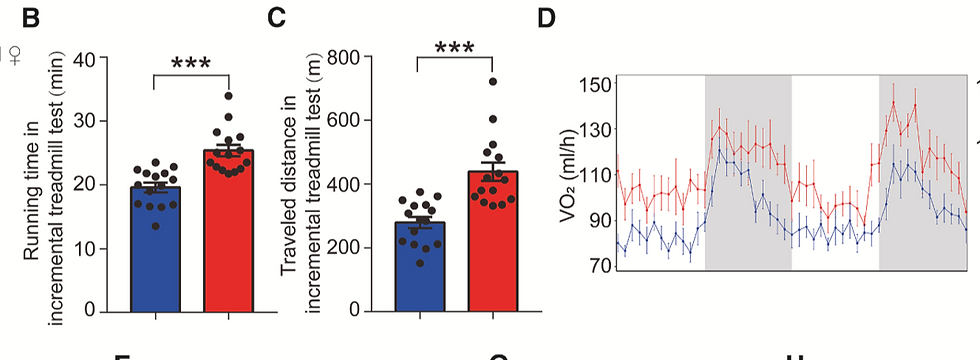
( Blue : Children of a father who doesn't exercise, Red : Children of a father who exercises)
Muscle Structure and Mitochondrial Density:
The muscle tissues showed an increased number of oxidative (endurance type) muscle fibers and fewer fast but easily fatigued glycolytic fibers.
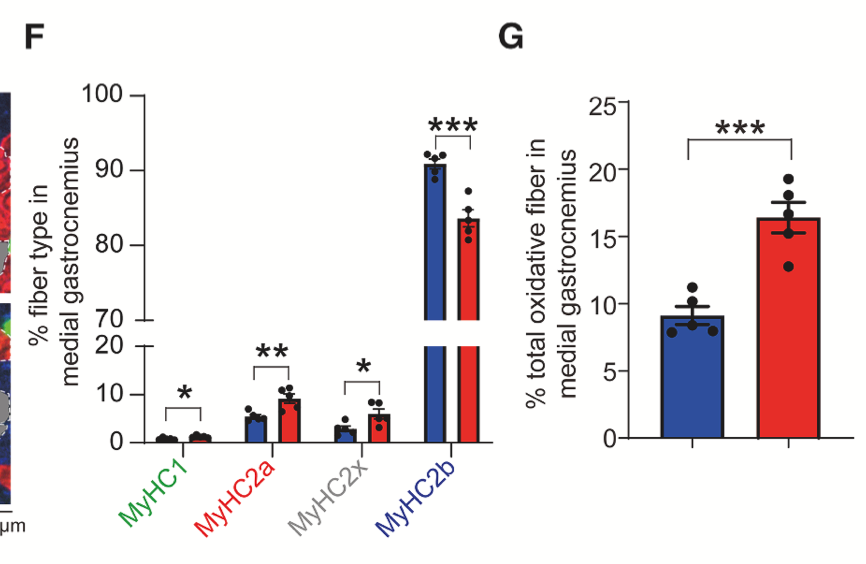
( Blue : Children of a father who doesn't exercise, Red : Children of a father who exercises)
Electron microscopy analyses showed a significant increase in the number and volume of mitochondria .
These mitochondria were also more active — meaning that highly efficient cells with a high energy conversion capacity had been produced.

MECHANISM
Finding that the difference was not in the DNA sequence, researchers examined the epigenetic content of the sperm . In the sperm of fathers who exercised, 17 microRNAs were significantly altered. Among these, miR-148a-3p stood out in particular.
This microRNA suppressed the NCoR1 gene , thereby increasing the activity of PGC-1α . As a result, the cell received the command to produce more mitochondria.
So when the father ran, he wasn't just shaping his own muscles — he was also shaping the muscle programming of his future child through his sperm.
SPERM RNA INJECTION EXPERIMENT: The Strongest Evidence Yet
To directly test this claim, small RNAs taken from the sperm of exercising fathers were injected into eggs of non-exercised fathers. The offspring born from these eggs were similar to the offspring of exercising fathers :
He ran longer,
It used higher oxygen levels.
He showed better glucose tolerance,
It had more mitochondria in its muscles.
In contrast, injections of long RNA or the control group showed no effect. Therefore, it was the short RNAs (specifically microRNAs) that made the difference .

Implications for Humans: We Also Have Similar MicroRNAs
Researchers also examined the same microRNAs in human sperm. They found that in men who exercised, just like in mice, levels of miR-148a-3p and several other microRNAs increased. This suggests that the mechanism is conserved across species and may work in the same way in humans .

CONCLUSION
This study provides strong experimental evidence suggesting that paternal exercise habits may be associated with physical endurance and metabolic efficiency in subsequent generations. The research reveals that this effect is transmitted not through genetic sequencing, but via microRNAs in sperm . Furthermore, it was shown that suppression of the NCoR1 gene in the embryo may be a key mediator in this process.
However, the results are currently limited to mouse models . While similar microRNA changes have been observed in humans, it is not yet known how and to what extent these changes actually affect the physiology of children. How exercise alters sperm microRNAs—whether through hormones, muscle-derived vesicles, or other means—is still unclear. Furthermore, the fact that the effects differ according to gender suggests that the mechanism is complex and partly specific.
Therefore, this study has clearly established a cause-and-effect relationship at the animal level , but further research is needed to determine how strong or clinically significant this relationship is in humans .
Exercise can create biochemical changes in a father's sperm — but the impact of these changes on human offspring is still a subject awaiting research.
Reference:
Yin X, Anwar A, Yan L, Yu R, Luo Y, Shi L, Li B, Chen J, Liang G, Chen Y, Tang J, Liang J, Kan Y, Zhang Z, Zhou Cell Metab. 2025 Nov 4;37(11):2167-2184.e8. doi: 10.1016/j.cmet.2025.09.003. Epub 2025 Oct 6. PMID: 41056946.


Comments