
The Movement Tempo in Lifting
Updated: 2 days ago
In weight training, the appropriate tempo for repetitions is a highly debated topic in the modern sports world. This debate is accompanied by differing opinions. Some argue for slow and controlled movements, while others advocate for fast and explosive tempos, each presenting their own reasoning to fuel the argument. This article will objectively address this debate, referencing the 2021 article "The Influence of Movement Tempo During Resistance Training on Muscular Strength and Hypertrophy Responses: A Review."

Movement tempo is the rhythm that defines the eccentric (lowering the weight), resting phase, concentric (lifting), and top position pauses of a repetition. This seemingly simple variable influences both immediate physiological responses and long-term adaptations .
WHY IS PACE IMPORTANT?
In theory, the tempo of the movement determines the time-under-tension (TUT) that the muscle experiences during a set . When a muscle remains under tension for a longer period:
metabolic stress increases,
hormonal responses intensify,
muscle signaling becomes more effective.
Fiber activation changes.
However, the reality is not as simple as " slower tempo = more time-under-tension (TUT) = more muscle growth" as it is in theory. Muscle growth consists of a complex mechanism involving the effects of various factors. Muscle growth is affected by weight, number of repetitions and sets, amount of rest, and type of exercise. These factors can also be directly and indirectly affected by tempo. We can better understand how tempo affects these factors with an extreme example: if we spend 120 seconds doing just one repetition of dumbbell curl, it will be impossible to reach 8-12 repetitions. If we want to reach this repetition range at the same tempo, we will have to reduce the weight drastically.
THE EFFECT OF PACE ON HYPERTROPHY
Muscle hypertrophy depends not on a single variable, but on many factors such as load, repetition count, number of sets, rest time, and how long the muscle is under tension (TUT). One of the most subtle yet powerful variables directly influencing these factors is tempo . Tempo defines the eccentric (lowering), isometric transition, concentric (raising), and hold durations of a repetition, and variations in duration in these four phases determine how the muscle perceives mechanical and metabolic stress. Therefore, when tempo changes, not only the "duration of the repetition" but also load selection, repetition endurance, muscle activation, and the metabolic response to training change.
Most research shows that consciously slowing down repetitions increases TUT (Touch-Up Reduction) , and that muscles under tension for longer periods can generate stronger hypertrophic signals. However, this doesn't always directly translate to growth; because tempo alone doesn't have an effect, but rather in conjunction with load, repetitions, and fatigue. When a slow tempo is used, the number of repetitions decreases, and the need to use lighter loads arises. Therefore, tempo can increase hypertrophy, but in some cases, it can also limit it. As emphasized in the article, hypertrophy tempo should be evaluated in conjunction with load and repetition number, as these variables directly influence each other.
A significant number of studies show that eccentric and concentric phases should be evaluated separately. This is because in the eccentric phase, the muscle can withstand higher tension and the tempo is changed in a more controlled manner, while in the concentric phase, the tempo is often determined by the load. Therefore, extending the eccentric phase produces controlled and noticeable results, while extending the concentric phase generally does not benefit hypertrophy. For example, Tanimoto and Ishii's 12-week study showed that slow tempos such as 3/1/3/0 (50% 1RM) produced much more hypertrophy than a fast tempo with the same load. 3/1/3/0 refers to a tempo of: 3 seconds eccentric (lowering the weight), 1 second pause, 3 seconds concentric (lifting the weight), and 0 seconds pause at the top. Furthermore, slow tempo + low load produced similar hypertrophy to fast tempo + high load; that is , the right tempo can compensate for the lack of light loads .
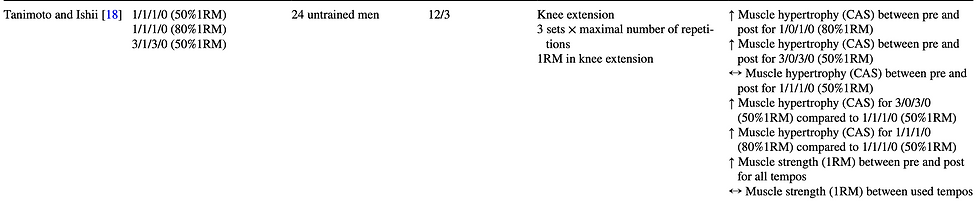
Similar findings have been observed in other studies. Both in single-joint and multi-joint training, tempos involving slow eccentricities (e.g., 3/0/3/0) have been shown to be more advantageous in increasing muscle thickness and CSA. In Watanabe's study, using the same weight , the 3/1/3/0 tempo resulted in significantly greater hypertrophy in the anterior quadriceps compared to the 1/0/1/0 tempo.

In contrast, exercises that were solely concentric, meaning those that prolonged the lifting phase (e.g., 3/0/3/0), often did not show a significant increase in growth. Nogueira's findings showed that a long concentric phase limited hypertrophy , while a long eccentric phase (such as 3 seconds) resulted in significant growth in the biceps. In the study, he observed that the thickness of the biceps brachii increased more when the weight was lowered slowly and lifted faster than when both were performed slowly.

The critical point here is that what matters for hypertrophy is not the increase in total duration, but the increase in the duration of the eccentric phase; that is, slowing the tempo while lowering the weight has been effective. Slowing the concentric (lifting) tempo does not make a significant difference for hypertrophy and can also increase muscle fatigue, reducing the total number of repetitions and lowering the Total Time Under Tension.
Literature has also shown that using very slow tempos (10 seconds and above) reduces growth potential due to lower load and insufficient motor unit activation. Therefore, tempo manipulation should be done in a balanced way.
Data show that tempo must be considered to enhance hypertrophy. Neither entirely slow nor entirely fast tempos are effective; the best results are obtained through a combination of slow eccentric and fast concentric phases. However, tempo cannot be considered independently of other training variables such as load, repetition count, and TUT (Term-to-Term) duration. Using a slow tempo requires reducing the load, but increasing TUT, especially when continued until concentric exhaustion, can create sufficient stimulation for hypertrophy. Conversely, light load + prolonged tempo, if not led to exhaustion, provides a stronger hypertrophic effect with heavier loads .
THE EFFECT OF TEMPO ON POWER
Pace of movement is a training variable that can influence maximal strength development; however, current evidence suggests that the primary determinant of strength increase is not pace, but specificity and load used . The greatest increases in strength are achieved when the type of contraction used in training and the testing methods are consistent, and when working with heavy loads (80–100% 1RM) .
Studies show that those who work with heavy loads, even with the same muscle size, demonstrate greater strength gains than those who work with light loads. Therefore, while pace is important, the magnitude of the load determines strength gain much more strongly .
Most studies have tested tempo differences of only 2–3 seconds by alternating eccentric and concentric durations, but have shown that these small changes do not create a significant difference in strength. These results have been replicated in both beginner and experienced athletes, in both single-joint and multi-joint exercises. Therefore, small tempo differences are not decisive in determining maximal strength .
Studies examining very slow tempos (especially very long concentric periods) have also shown that strength does not increase significantly. In fact, excessively long repetition durations can limit strength development by creating a stimulus that resembles endurance rather than strength due to high TUT (Total Tension).
Another factor that complicates understanding the effect of movement tempo on strength is that most studies alternate eccentric and concentric phases simultaneously, making it difficult to discern which phase is the most effective. One of the few studies that alternated only one phase showed that slow eccentric (4 seconds) execution could increase strength in a single-joint exercise like a biceps curl; however, further research is needed to generalize this finding to multi-joint exercises.
The literature on this topic is contradictory; this is because most studies have been conducted with parameters that are not optimal for maximal strength, such as light-to-moderate load, high repetition, and long set durations. In actual strength training, the concentric tempo already slows down at heavy loads, and the muscle cannot voluntarily slow it down.
CONCLUSION
The results of this review demonstrate that repetition tempo is an important variable that can influence both hypertrophy and strength development in resistance training, but the current literature lacks a clear and consistent conclusion. Differences in muscle groups used, program structures, load-repetition patterns, and experimental methodologies in different studies explain why the findings between fast and slow tempos are contradictory.
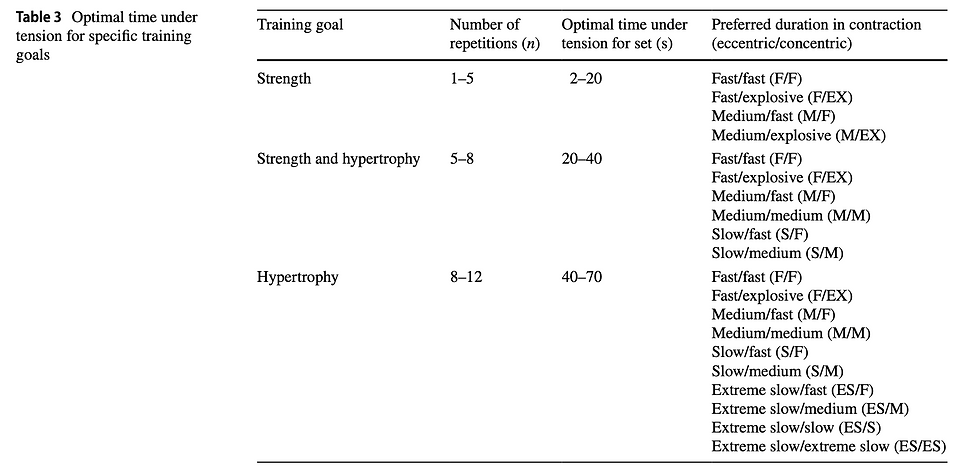
In general, neither entirely slow nor entirely fast tempos alone appear superior when aiming for hypertrophy. Studies most often show that a controlled, slower eccentric phase and a faster concentric phase are the most favorable approaches for muscle growth. However, tempo cannot be considered independently of other training variables such as load, repetition count, and total duration of tension (TUT). While a slow tempo may require reduced load, it can still generate sufficient anabolic stimulation by increasing TUT. Indeed, Table 3 shows that for hypertrophy , 8–12 repetitions , 40–70 second TUTs , and tempo combinations that support both duration of tension and motor unit activation, such as slow-fast (S/F), medium-fast (M/F), or fast-explosive (F/EX), are commonly preferred.
Regarding strength increase, current studies do not show a clear superiority of one tempo over another. However, it is thought that fast concentric efforts may contribute to strength development because they better stimulate neural adaptations. Conversely, slowing the eccentric phase may indirectly contribute to strength by increasing hypertrophy through muscle activation and metabolic stress. However, the literature is inconsistent here as well, and a significant portion of the results depend on load intensity and specificity rather than tempo change . Table 3 supports this, emphasizing that 1–5 repetitions , short TUTs of 2–20 seconds , and tempo options prioritizing speed such as fast-fast (F/F), fast-explosive (F/EX), and moderate-fast (M/F) are the most suitable ranges for maximal strength development. These recommendations confirm that load and neural stimulation are more decisive factors in strength than tempo variables.
Finally, future research must necessarily evaluate the durations of the eccentric and concentric phases separately. This will allow for a more accurate understanding of the true effect of each phase on hypertrophy and strength. Furthermore, the lack of studies with longer durations, high loads, and advanced athletes currently limits our understanding of the role of tempo in real-world training applications.
Reference:
Wilk M, Zajac A, Tufano JJ. The Influence of Movement Tempo During Resistance Training on Muscular Strength and Hypertrophy Responses: A Review. Sports Med. 2021 Aug;51(8):1629-1650. doi: 10.1007/s40279-021-01465-2. Epub 2021 May 27. PMID: 34043184; PMCID: PMC8310485.


Comments